
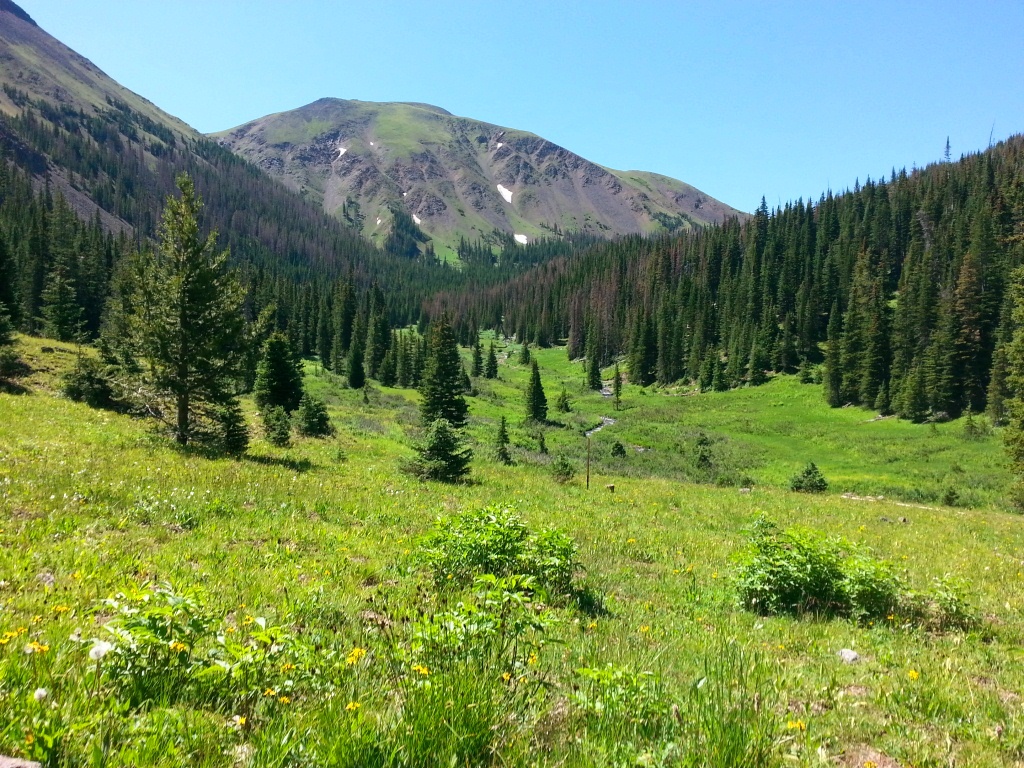
image by Eric, American Lakes trail
1. Wisdom from Ishita Gupta, “Every woman in the world knows what she needs in the moment. Whether or not she gives it to herself is the question.”
2. Yoga meets art — create a life you love, on Rebelle Society. I must be tender from my weekend of yoga teacher training because this made me cry. Another good one from Rebelle Society is 13 Awesome Characteristics of Highly Sensitive People, which gives one of the best descriptions I’ve ever read of ME.
3. A Map of the Introvert’s Heart by an Introvert on Medium. If you’ve ever felt like you didn’t understand me, this might help.
4. Wisdom from Mary Oliver, because every once in a while I need the reminder,
You do not have to be good.
You do not have to walk on your knees
For a hundred miles through the desert, repenting.
You only have to let the soft animal of your body
love what it loves.
5. Wisdom from Krishna Das,
We constantly limit ourselves with our emotions and our desires and our stories. When we identify with that stuff, we don’t experience what’s underneath it. The only way to move deeper into your own heart is by doing some kind of spiritual practice, regularly, over time. That’s what helps us experience real love and gives us the strength to manifest changes in our lives.
6. Fiercely Being from Jonathan Fields. This one is important. If you don’t click any other link on this week’s list, please follow and read this one. And just in case you are going to ignore my plea, here’s the line where I tear up and put my hand over my heart each time I read it because the beauty and truth are so clear it almost breaks my heart, “What if your metric was…’Do things that light you up with people who light you up for people you love to serve.‘”
7. You Are Not Late, by Kevin Kelly on Medium, (thanks to Austin Kleon for sharing the link in his newsletter).
8. the lively show: radical sincerity & mental health advocacy with esmé weijun wang, (originally shared by Pugly Pixel).
9. Alone in the Wilderness, a documentary that “tells the story of Dick Proenneke who, in the late 1960s, built his own cabin in the wilderness at the base of the Aleutian Peninsula, in what is now Lake Clark National Park…covers his first year in-country, showing his day-to-day activities and the passing of the seasons as he sought to scratch out a living alone in the wilderness.” We got this from the library a few times and loved it. Someone has now made the full film available on YouTube.
10. Good stuff from Seth Godin: This is ours and The easy ride.
11. Why scales make you binge-eat from Isabel Foxen Duke.
12. I love Lisa Congdon’s Words for the Day. These are some of recent my favorites: No. 22, No. 23, and No. 30. And also from Lisa, a beautiful post about marriage, On Marriage :: A Year Later.
13. Good stuff from Jeff Oaks: Habit and Nothing.
14. What Makes You Feel Free? by Saundra Goldman, (link shared by Stephanie).
15. A Bank Uses Its ‘ATMs’ To Say Thanks To Regular Customers In The Most Personalized and Heartfelt Way. Hint: It wasn’t Bank of America.
16. Be Full of Yourself, from Julie Daley.
17. Choose love, and have it be that simple from Sandi Amorim.
18. Rekindle Your Love for Simplicity from Be More With Less.
19. 31 Benefits of Free-Writing from Cynthia Morris.
20. Truthbomb from Danielle LaPorte, “Only seek to be more of yourself.”
21. Wisdom from “Joseph Campbell and the Power of Myth (with Bill Moyers),” shared by Sandi Amorim,
This is an absolute necessity for anybody today. You must have a room, or a certain hour or so a day, where you don’t know what was in the newspapers that morning, you don’t know who your friends are, you don’t know what you owe anybody, you don’t know what anybody owes to you. This is a place where you can simply experience and bring forth what you are and what you might be. This is the place of creative incubation. At first you may find that nothing happens there. But if you have a sacred place and use it, something eventually will happen.
22. African cocoa farmers taste chocolate for the first time.
23. Urban Jewelry: Lace Street Art by NeSpoon shared on This is Colossal.
24. 10 Ways to Recognize Orthorexia on New York Magazine.
25. Wisdom from Pema Chödrön, (read the full piece here),
Bodhichitta exists on two levels. First there is unconditional bodhichitta, an immediate experience that is refreshingly free of concept, opinion, and our usual all-caught-upness. It’s something hugely good that we are not able to pin down even slightly, like knowing at gut level that there’s absolutely nothing to lose. Second there is relative bodhichitta, our ability to keep our hearts and minds open to suffering without shutting down.
Those who train wholeheartedly in awakening unconditional and relative bodhichitta are called bodhisattvas or warriors — not warriors who kill and harm but warriors of nonaggression who hear the cries of the world. These are men and women who are willing to train in the middle of the fire. Training in the middle of the fire can mean that warrior-bodhisattvas enter challenging situations in order to alleviate suffering. It also refers to their willingness to cut through personal reactivity and self-deception, to their dedication to uncovering the basic undistorted energy of bodhichitta. We have many examples of master warriors — people like Mother Teresa and Martin Luther King — who recognized that the greatest harm comes from our own aggressive minds. They devoted their lives to helping others understand this truth. There are also many ordinary people who spend their lives training in opening their hearts and minds in order to help others do the same. Like them, we could learn to relate to ourselves and our world as warriors. We could train in awakening our courage and love.
26. I took this quiz, Which Jung Archetype Best Describes You? and got “The Caregiver.”
Jung identified this archetype in many goddesses and female role models throughout history. You’re the mother figure: the selfless caregiver and helper. Everyone comes to you for advice. You truly love others as yourself and your greatest fear is selfishness and ingratitude. You manifest compassion and generosity. A Jungian psychologist would tell you to be careful not to be taken advantage of and never let yourself play the martyr.
27. Lacy M. Johnson on The Art of Mourning, on Essay Daily.
28. A young man asks a homeless man to borrow his bucket, what happens next will burst you into tears.
29. I think I fucked this up from The Bloggess.
30. Be Your Own Guru, a Good Life Project Jam Session, another really good thing from Jonathan Fields.
31. Courageous Company with Anna Guest-Jelley: Why Wearing a T-Shirt Might Have Changed My Life.
32. 10 Smarter and Less Stressful Ways to Get Your Daily Work Done on the Positivity Blog.
33. 16 Of The Most Magnificent Trees In The World on Bored Panda.
34. Good stuff from Zen Habits: Inhabit the Moment and How to Master the Art of Living.
35. Doing everything wrong: Shame, truth-telling, and writing it out on Visible and Real. This line especially, “And if I am not Worthy, I move in one of two directions: Complete Shutdown or Overperforming. {Either end of this pendulum is exhausting.}” Word.
36. One of my favorite projects is Humans of New York. Brandon has a new book coming out. He says about it,
Little Humans is coming out in almost two months, and the first hardcopy has just arrived! It is awesome. Your child is guaranteed to giggle, point, and cheer. And if test readings are any indication, there is a 38.53% chance you will cry. It comes out October 7th — very excited about it.
The absolute, most sure-fire way of physically moving in the direction of your dreams, Jill, on a day-to-day basis, without messing with the “cursed hows,” is living them, now, to any degree that you can.
38. Really good stuff from Medium: After (one of the best things I’ve ever read about the loss of a pet), and My Cousin is Not a Hero.
39. Wisdom from Elizabeth Gilbert on Facebook.
40. Dealing with anger before it deals with you from Paul Jarvis.
41. A Blessing from Ronna Detrick,
When you have questions, look to love. When you have doubts, turn toward love. When you wonder about next steps, let love be the deciding factor. And when you fear how it will all work out, trust in love.
I know it feels fearful to risk (and love) in these ways. I know you long for the certainty that the love you give will offer you the same in return. And I know that without guarantees, without promises, and without thought for your own safety, you will love anyway. It’s who you are. It’s what you do. And it’s the story for which you are known and named.
Speak. Risk. Stand. And love and love and love.

 Open Space Practice, (AKA: A Thousand Shades of Gray)