

I am posting late today, kind and gentle reader. I went hiking with my boys this morning, a long and quiet time together, space and silence that I sorely needed. This post was waiting for me to write it, but I knew that if anyone would understand the choice to be out in the green instead, it would be my dear friend Courtney Putnam.
 I haven’t actually met Courtney in person, and yet she’s one of my favorite people, a true friend. A few years ago, a piece of her art was selected for the cover of a reader being used in the English Department at Colorado State University, and the Composition Program director at the time, friends with Courtney’s mom, told me, “you and Courtney need to know each other.” We became friends on Facebook, and the connection was immediate and true. We have lots in common, but more than that, Courtney is pure magic, pure medicine, full of courage and love and joy.
Courtney describes herself this way, “Solopreneur of Rising Bird Healing Arts in Seattle, WA. Massage therapist, Reiki Master, Intrinsic Coach®, artist, writer, teacher,” a Creative Healing Artist.
I told her when she emailed her responses to these questions, “As with every interaction, every time we connect, every time you touch or encourage or inspire me or make me smile, I feel the deepest longing, make a wish that we were closer, that some day, some day…” Some day we will meet, have a long conversation over tea, but for today I am so happy to share her perspective on self-compassion with you, a thing both powerful and gentle.
 1. What does self-compassion mean, what is it? How would you describe or define it?
I love that the word “compass” is nestled in that word compassion. So is the word “passion.” In self-compassion, the compass points to yourself; the passion for self-understanding is part of our mission. Self-compassion is self-love, self-empathy, self-mercy. Self-compassion is the act of saying YES to yourself, of sending the message “I matter,” and of experiencing self-love even when self-loathing has the louder voice.
For me, self-compassion is making room for all that I am, even with my struggles, illnesses, challenges, pain, and insecurities. Self-compassion says, “That’s okay, I still love you” to pain even when pain writes me a letter that says, “Dear Courtney, I hate you. Yours, Pain.”

TrustYourself by Courtney Putnam
2. How did you learn self-compassion? Did you have a teacher, a guide, a path, a resource, a book, a moment of clarity or specific experience?
The human body has been my primary teacher in my journey with self-compassion. The body forgives us, doesn’t hold grudges, and is constantly working to create equilibrium for us. It does this naturally, innately, and autonomically. We don’t need to ask our bodies to work on our behalf: it does so with complete humility and love.
I have been a bodywork practitioner for over eleven years, and I have had the honor of working with people and their amazing, wise, truth-telling bodies. What I have learned is that the body we inhabit knows only self-compassion and self-acceptance, even though our minds often don’t. We can be very hard on our bodies – not only in how we ask a lot out of them physically, but also in the way we think about and talk to them. And we can ignore the messages of the body completely, which makes the body’s self-healing/self-compassion system have to work harder.
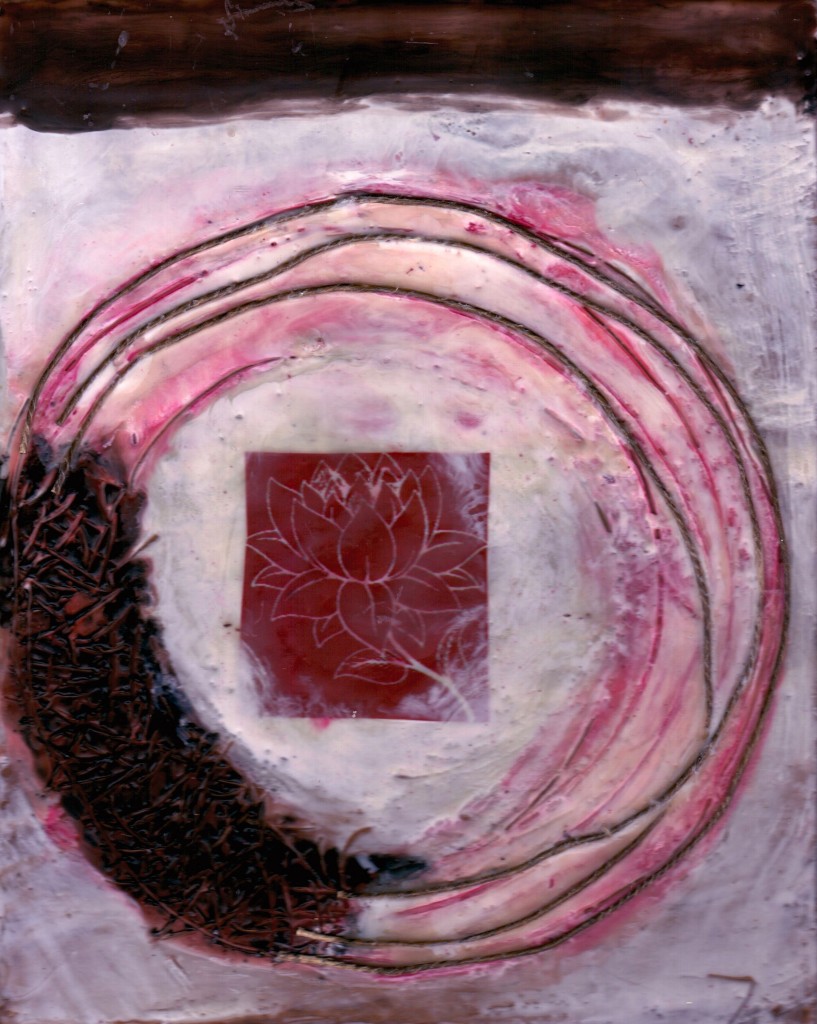
ScarMatrix by Courtney Putnam
The body is a barometer for how we are doing and in my work I see the deep interconnection between the mind and body. Our bodies want to be acknowledged. It’s a very simple process, but sometimes hard to do because we have so many thoughts and feelings in the way – worry, anxiety, self-loathing, grief, sadness.
Here’s an example of how self-compassion is my teacher and guide during my sessions:
When there is tension or pain, I place my hands where I feel stuckness and I ask my client, “What is here?” or “What is it like for you right in this spot?”
I hear answers like, “My grief lives here. It’s spreading like wildfire. It’s red. Burning, burning.”
I ask: “What does this spot want? Listen. Allow the messages to come….”
Client: “It wants air, moist cool air. It wants to cool down. It wants me to cool down. My grief needs room to breathe. It doesn’t like being contained in the fire.”
Me: “Let’s give this place cool, moist air then, okay? Imagine your next breath is cool air filling your whole chest, soothing everything.” [I place my hands on my client’s diaphragm and ribs.]
Client: [She breathes a few times. The body receives the acknowledgment of the pain, of the hot grief, the constriction — and in response to the attention and intention, the breath deepens, the heart opens. Tears flow.] “I have more room now. The red is turning green with pink on the edges.” [Another big breath surfaces naturally.]
Me: “Now what does this spot in your body have to tell you? What are you noticing?”
Client: “I hear ‘Thank you’ coming from the grief. And the grief isn’t burning through me. It’s more like it’s flowing like a river. It’s cooler, softer.” [My client’s body whole body softens.] “I also hear that I’m okay, even with this grief, right in this moment I am okay.”
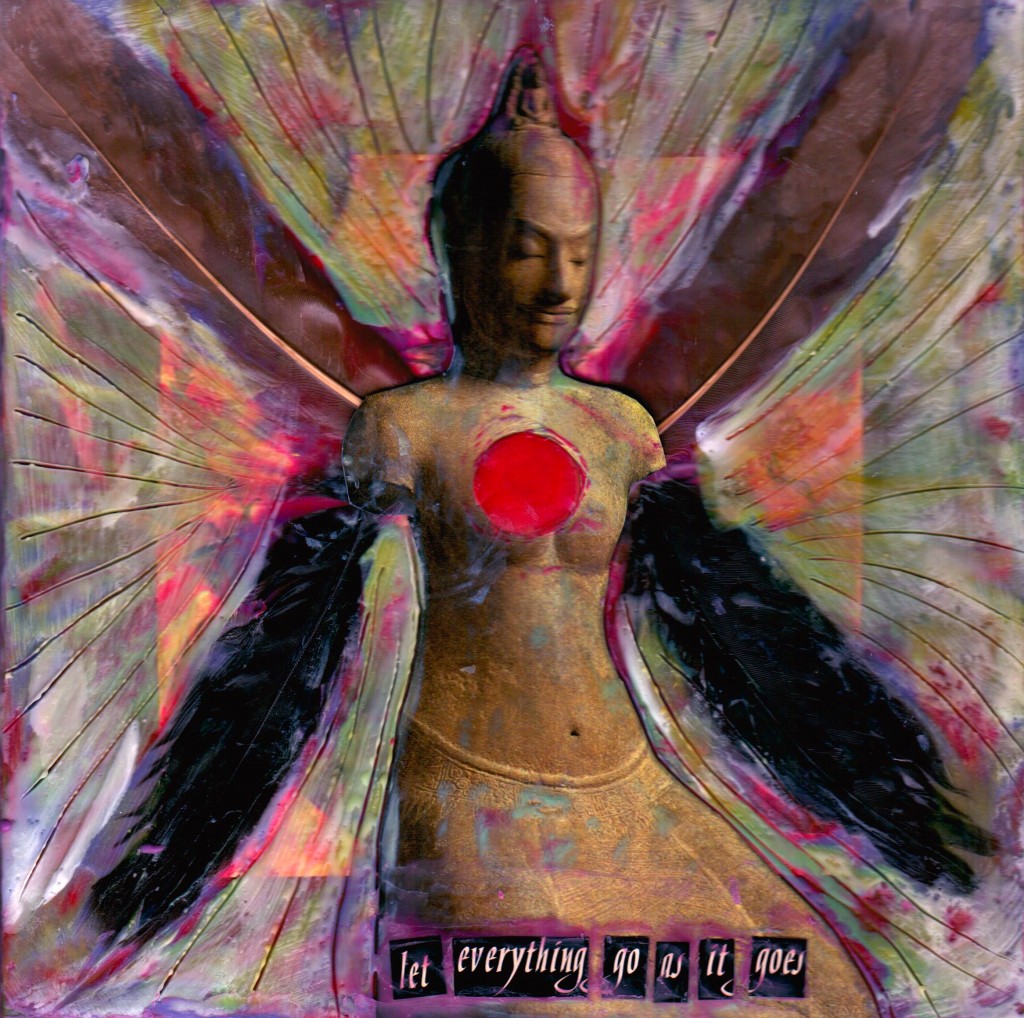
LetEverythingGo by Courtney Putnam
The body loves to be heard and our act of listening deeply and asking what our bodies want or need to tell us is self-compassion embodied.
Compassionate transformation happens when we notice + ask what is needed + listen + breathe in what is needed.
3. How do you practice self-compassion, what does that experience look like for you?
My self-compassion practice has many incarnations, including …
… asking my body what it needs and then obliging its request
… dancing to KC and the Sunshine Band in the living room wearing sequins and feathers
… napping with my cat Selkie (in the middle of the day, even when it is beautiful out)

Courtney and Selkie
… crying while creating mixed media collages and listening to Sigur Ros
… writing YOU ARE OKAY in dry erase marker on my bathroom mirror
… reciting these mantras when I feel anxious: “ride the wave, it will pass” and “just be with it, don’t resist”
… saying “no” to going to an event or party
 4. What do you still need to learn, to know, to understand? What is missing from your practice of self-compassion, what do you still struggle with?
Oh goodness, there are oceans and caverns and mountains I still need to learn when it comes to self-compassion. For starters, it is much easier for me to help others with self-compassion than it is to help myself. Helping my clients, my friends and my family with self-love and self-healing comes naturally, but when it comes to my own self-nurturing, I have to work at it. I know a lot of people in the helping professions would agree with me on this. We often give and give and neglect to receive. We can fray at the edges, feel the weight of other people’s problems, and exhaust ourselves. We neglect to ask for help or to take the time to give ourselves the same attention we give to others. I have to be very attuned to my own body’s messages – and learn to take breaks, say “no,” or ask for support from others. As of this writing, I am giving myself a huge helping of self-compassion: I am taking a summer sabbatical from my bodywork practice to recharge, recalibrate, and soak up some self-nurturing time. I hear my body gently whispering yes yes yes.
 I am so filled with gratitude and love for Courtney, for taking the time to share her responses, for doing the work she does, for being just who she is. As I told her, I so needed to hear her talk about the body being connected to the practice of self-compassion, and when I read this the first time, “We don’t need to ask our bodies to work on our behalf: it does so with complete humility and love,” it made me have to pause and cry a little.
To find out more about Courtney, to connect with her:
- Visit her website
- Read her blog
- Take an ecourse with her
- Buy her art
- Watch one of her videos on YouTube
Next on Self-Compassion Saturday: Tammy Strobel.
P.S. If you didn’t see the first post in this series, you might want to read Self-Compassion Saturday: The Beginning.


 Open Space Practice, (AKA: A Thousand Shades of Gray)