Monthly Archives: October 2015

Day of Rest

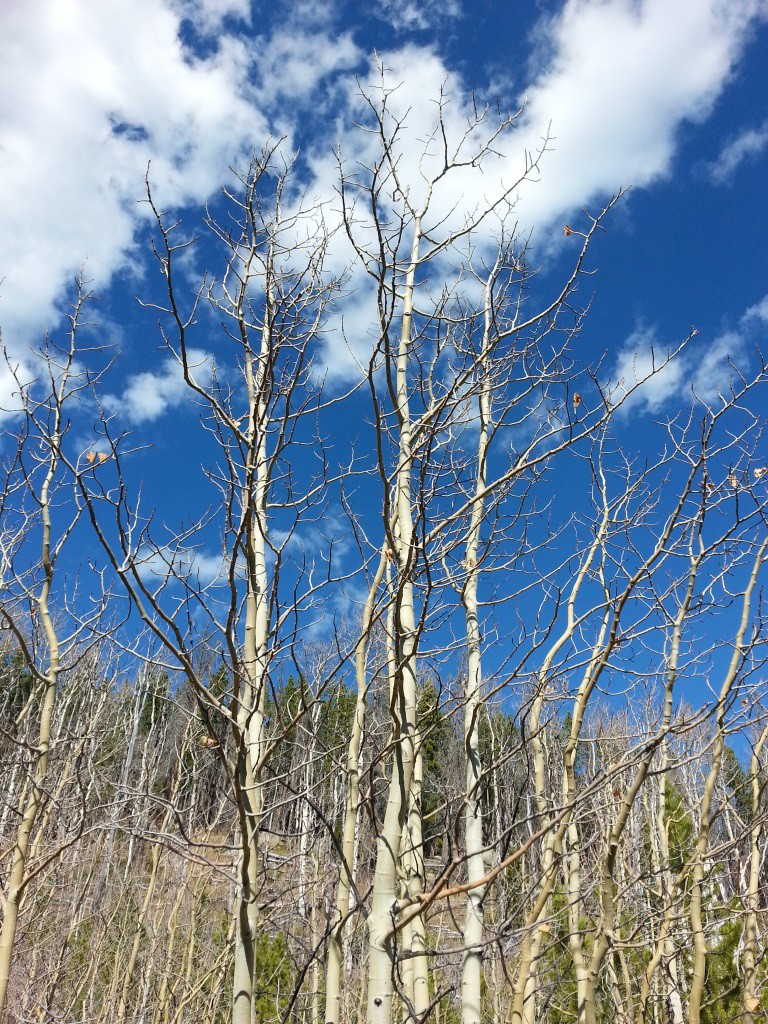
Bare Aspen trees, Pinagree Park, image by Eric

Bare Aspen trees, Pinagree Park, image by Eric

I get melancholy this time of year, every year. The garden stops producing, the leaves turn color and fall, the days get colder and darker. I love wool socks and hot soup and down blankets and snuggling, but the turn towards winter is bittersweet. Having lived almost 48 years, I have some pretty good evidence that this is a season that will pass like all the others, that spring and summer will come again, that there will be another garden next year, and enough light and warmth that I’ll even start to complain about how hot it is all the time, and yet somehow it feels so final, so sad.

But as life is, it’s a mix of tender and terrible, beautiful and brutal. At the same time I felt sad to see that the aspens at Pinagree Park had already lost all their leaves, I was filled with joy this morning — I took a 3 mile walk, y’all! I’ve been dealing with this foot thing (plantar fasciitis) for about ten months. For the first six, I didn’t realize it was a thing. I blamed my shoes. I blamed sleeping “wrong” on it. I blamed an extra intense yoga practice or not stretching enough or not drinking enough water or sitting too long or standing too much. I even started running again, not realizing it was a real problem. Four weeks into that it was clear it was an actual thing I needed to deal with, that wasn’t going away, and I did some research and realized I was going to need help and rest and time. I’ve been doing physical therapy for almost three months and resting it for close to two, and it’s finally getting better. This morning I decided to see where my edge was, go a little further, see if I could start building my way back up to the six mile morning walk. It was one of the best walks ever. I felt so…normal.

Next week I’m meeting with my therapist for the last time. I’ve been working with her for about 2.5 years. When we started working together, Dexter was dying and I’d just seen a doctor who told me I was obese and tried to put me on a diet (right after I’d told her I had an eating disorder, was over exercising, and suffering ongoing fatigue). I had a mild form of PTSD, wasn’t sleeping very well, dealt with both anxiety and depression regularly, and felt generally miserable. I wanted help, knew that developing my self-compassion practice was the place to start. Since then, my therapist and I have worked through some hard stuff together. I’m stronger and  more sane, better off for my time with her.

And now it’s time to quit. It’s been a few months that I’ve known, but when you have that kind of long term, ongoing, positive support in your life, it’s hard to give up even when you stop needing it. For quite some time, we’ve only been meeting once a month, and the past few times she was functioning more as a business coach than a therapist (another thing she practices), and the last time it was obvious I’d outgrown the need for therapy. I told her it was an odd profession she was in, where the measure of her clients’ success was that they didn’t need her anymore. We are meeting one more time to wrap up, review, say goodbye, have some closure. It feels a bit like when I broke up with my trainer, another moment when I rightly took back my power, was strong enough to take charge, take care of and responsibility for what’s mine, for myself.

And that’s just it, I need to take myself back. This is just one way I’m doing that, but there are lots of other ways too. I’m working to stop looking outside myself for permission, for approval, for direction. I’ve learned that no one needs to tell me what to eat, when or how much. No one gets to tell me how my body should look or how I should move. No one can tell me how to practice or what is true. I don’t need anyone’s advice or agreement. I can ask for help when I need it because I know what I need. I can, but I also don’t have to. Even as I’m connected, part of a larger community, I can take care of myself. I’m not going to let fear of failing stop me from trying. I’m not going to give up.
Big Magic Read-a-Long: Courage

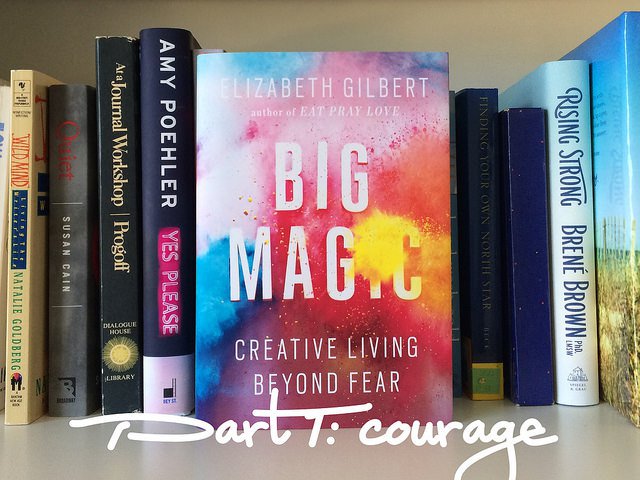
image by Justine

image by Justine

My friend and one of my favorite bloggers Justine is hosting a read-a-long for Elizabeth Gilbert’s new book, Big Magic: Creative Living Beyond Fear. Justine provided prompts for the first section of the book on her blog, and invited readers to respond in the comments or send her an email. At first, I was going to journal about the prompts this morning, then send her an email, along with some times when I could Skype so we could discuss it the next time we talk, but as I started to write out the first prompt in my journal, I thought to myself, “why don’t I just blog a response?” Duh. It’s funny how much work I’ve put into cultivating this space, but then I forget to use it other times when it’s so obviously the right place for something.

Justine’s prompts for the first section of the book are:

  • What are some of the fears that crop up when you think about living a more creative life? My first fear, the most immediate one right now as I consider how I might shift the way I make my living to be more focused on my creative pursuits, is money — how will I make any money if this is how I’m spending my time? Which leads directly to the next fear — time. I worry that I don’t have enough time, that I don’t have the energy or space or days left it will take to accomplish all the things I want to do. After that comes the deep longing to make a difference, to help, to be of service, and wondering if what I do does those things. I also worry about the amount of time my creative pursuits take away from what I can give to Eric and the dogs, the time I can spend with family and friends — am I cheating them, am I giving enough attention there? And finally, (and you’ve heard me say this before, recently), I’m afraid I’m boring, that what I have to offer won’t be meaningful to anyone else. These fears all stem from the same fundamental confusion: I think that living a creative life has to have a product that is worth something, an outcome that is valuable enough to justify itself. It goes back to that same, original confusion: that I have to earn the right to be here, to have the life I want.
  • Like Gilbert’s friend who started ice skating again at 40, what life affirming pursuits are you denying yourself? How can you begin “to appreciate the value of (your) own joy”? I’m most definitely denying myself joy. I think I have to accomplish a certain amount first, that joy is the reward for hard work rather than a necessary condition of living. Things I don’t do as much as I’d like: read, nap, relax, laugh, pause, make art for art’s sake, practice yoga, stretch, sit in the sun, go outside, hike, take long walks, ride a bike, garden, follow my curiosity, spend time with friends, play with my dogs, do nothing, have no plans, focus on one thing at a time. I’d like to learn how to swim and play the ukulele, take singing lessons or a painting class. But even these things I can turn into a project if I’m not careful. How I can begin is to stop, as weird as that might sound. To stop doing, stop trying, stop planning. Just stop and see what happens, wait for what might arise.
  • Gilbert tells the story of arguing for her own limitations.
    1. Why do you think it feels easier to argue for our limitations rather than for our strengths? We are so desperate to let ourselves off the hook, somehow think that it’s easier to give up. We make a lot of effort to avoid what is hard thinking we can get ourselves out of it somehow. Fundamentally we are struggling with the truth of how hard life is, how vulnerable we are, what a raw deal it is that we love and delight and enjoy our life just to one day lose everything. If we can hide away in our cocoon of excuses, we think we can skip that part, pretend it away. It makes me think of the Pema Chödrön quote, “To be fully alive, fully human, and completely awake is to be continually thrown out of the nest.” We think we can excuse ourselves from that experience if we have a good enough reason.
    2. What limitations of your own do you argue for? I can’t because I have too many responsibilities, things I have to do first. I can’t because I’m too tired, not strong enough. I don’t have enough time. Why should I have to when she/he isn’t doing anything? Why can’t my life be easy? It’s harder for me. I work so hard, shouldn’t I get a break? I didn’t start early enough. I’m too sad, too stressed out, too many bad things have happened.
    3. What thinking, saying or action can you embrace to argue for your strengths instead? Being present always feels better than being numbed out. No matter how scary or difficult the situation, my innate wisdom and compassion will guide me — I always know what to do, even if it’s to admit that I don’t know what to do. Doing the hard thing is so much easier than what it would take to avoid it. Showing up with an open heart is my superpower.
  • Write a welcoming speech for your fear. Maybe instead of a road trip your metaphor is a camping trip or running a marathon. Whatever the situation, how can you welcome and acknowledge fear and still keep the reins firmly in your creative hands? In my Buddhist lineage, I was given a teaching that included placing the mind of fear “into a cradle of lovingkindness.” My fear always seems to me like something very young and afraid, vulnerable and sweet, easily invited to crawl into my lap and rest. I can also easily imagine it clinging to me like a baby orangutan. In all of those circumstances, there’s not much of a speech involved. All I offer is the invitation to “come here” and the reassurance that “it’s okay.”
  • As you go about your week, think about approaching your day with curiosity instead of fear. What does that shift for you? Does it create any ease? There’s a lot of talk recently in the books I’m reading, most specifically this one and Brene’ Brown’s Rising Strong, about shifting to being curious. This non-judgmental approach, this leaning into what’s happening with an open mind and heart, allowing whatever might arise and being curious about our reaction rather than immediately reacting is something I already practice, in all the ways I practice — yoga, mediation, writing, and dog. I’m so lucky to have been taught this in all my traditions, to know this is an option and to have seen the outcome in my own experience. This approach shifts absolutely everything, creating ease and space and sanity.

Thank you Justine for the prompts, for the chance to get to think about these things, contemplate and reflect. I especially appreciate the way listing my fears made it clear that they really are all the same fear underneath.