

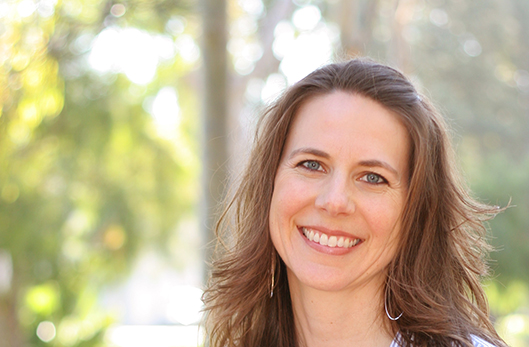
I am so pleased to be introducing you to Kristin Noelle’s perspective on self-compassion today, kind and gentle reader. She is every bit as kind and gentle as you, is the most generous, warm-hearted person. Time and time again she has offered me inspiration and comfort, freely and without ever having met me. Just yesterday, she made a video Trust Note that was exactly what I needed to hear.
Kristin describes herself this way, “I’m a trust coach. I write, speak, teach, make art, and listen deeply, all to help trust grow,” because “I see trust as our world’s most potent source of transformation.” She describes her Trust Tending work as “nourishing Life beyond fear.”
 1. What does self-compassion mean, what is it? How would you describe or define it?
When I think of self-compassion, I often hear in my mind a line from Sarah McLachlan’s song “Adia”: We are born innocent. And then further, We are *still* innocent. We make messes of things absolutely, and hurt ourselves and one another in all sorts of ways. But at heart, I believe we’re each, given our genetic make-up and life experiences, doing the best we can.
The more closely I look at the harm we cause and the messes we make, the more I see scared, childlike parts of us just responding like children do. Which elicits something so different than judgment for me. I feel sadness about the fear, and sometimes anger at all that causes fear to take root. But my basic stance toward those scared, childlike parts is kindness.
Self-compassion is me extending this kindness, and this confidence in my core innocence, to my own self – even when I wish my feelings or actions or nature could be different.

art by Kristin Noelle
2. How did you learn self-compassion? Did you have a teacher, a guide, a path, a resource, a book, a moment of clarity or specific experience?
In my early twenties (I’m nearing 40 now), I suffered the loss of my childhood faith. By that I don’t mean faith *in general*, but a particular worldview I’d known and been devoted to since childhood. That loss so befuddled family, friends, and mentors, that I found myself, quite shockingly to my good-girl self, making a choice between maintaining the approval of so many I cared about, and honoring my own soul. I chose the latter.
Something about that experience cracked me wide open. It was so unexpected and painful, and preceded by such pure-hearted devotion, that I felt like my eyes got totally remade. Instead of the lines I’d previously seen around “good” and “bad”, “holy” and “profane”, I started to see the childlike innocence in everyone around me: in myself, as I pursued truth and integrity the best ways I knew how; in those around me at the time, whose religious identities and experiences caused them to think me gone astray; in those who had no context to understand or appreciate the misery my loss of faith was causing me.
I more readily saw with eyes of compassion than ever before.
Through that time and all these many years since, many authors and teachers put words to this deep innocence I started to see, deepening my sense of it. These included poets David Whyte and Mary Oliver; novelists Shusaku Endo, Chaim Potok, Paulo Coelho, Sue Monk Kidd; memoirists Etty Hillesum, Will Campbell, Karen Armstrong, Anne Lammott, Rachel Naomi Remen; philosophers Rene Girard, Jacque Ellul; psychologists/psychotherapists Carl Jung, Richard Schwartz, Carol Dweck; Buddhist/spiritual teachers Pema Chodron, Jack Kornfield, Adyashanti, Meher Baba.
I’m sure I’m forgetting more folks who have shaped me deeply.

art by Kristin Noelle
3. How do you practice self-compassion, what does that experience look like for you?
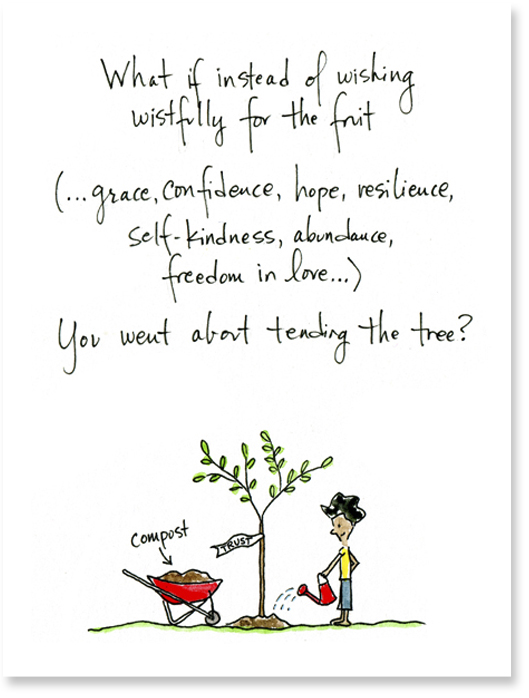
Self-compassion takes many forms for me, but I think they all begin with consciousness – getting conscious of judgmental, critical, or shame-based thoughts about myself. The more I practice awareness, even when I don’t follow up on that awareness with self-kindness, the more I feel myself changing. I feel much more resilient now than I was five or ten or even one year ago, for example – much more able to shift out of non-compassion and into compassion once I notice myself lacking it.
I consider thoughts like, “Huh. I’m being critical of myself right now,” totally worth celebrating.
art by Kristin Noelle
4. What do you still need to learn, to know, to understand? What is missing from your practice of self-compassion, what do you still struggle with?
I struggle to accept my pace a lot – related to goals around work, goals around my yard and home, changes I’d like to make in habits and relationships. My pace feels slower than I’d wish it to be. I imagine myself looking back on the me of today with so much compassion for the shame I feel around that, and the suffering that my impatience with myself causes me.
 I don’t know about you, but I feel calmer, more peaceful simply reading Kristin’s answers, looking at her art, seeing her kind smile — this is the impact her work, her presence, her offerings always have on me, and why I am filled with so much gratitude and love for her, today and always. To find out more about Kristin, to connect with her:
- Visit her website, read her blog
- Sign up for her Trust Notes, (no really, sign up, they are magic, medicine)
- Take an ecourse with her
- Do a Deep Listening Session with her, (I haven’t done one yet, but am saving up the opportunity for a special occasion — maybe my birthday this year?)
- Read and share her Letter from the Universe
- Follow her on Twitter and on Facebook
Next on Self-Compassion Saturday: Anna Guest-Jelley.
P.S. If you didn’t see the first post in this series, you might want to read Self-Compassion Saturday: The Beginning.


 Open Space Practice, (AKA: A Thousand Shades of Gray)