

Yesterday, I caught myself “shoulding” — “you should write this post early and have it ready to publish first thing in the morning, at midnight even, because people are waiting for it, and if not that, you should work on it first thing and publish it as early as possible.” I was able to stop myself because it doesn’t make sense for a post about self-compassion to be pushed, to be a should.
Instead, my morning looked like this: I meditated, wrote my morning pages, reread Mary Anne Radmacher’s latest book, took a long walk with Dexter, had a hot shower, and savored my breakfast — then I turned on my computer. I was able to “turn down the volume of demands and listen to the grace of the small, the silence, the whisper,” and I was “aware that my life is a walking poem, meditation, praise and prayer,” just like Mary Anne suggests in Honey in Your Heart: Ways to See and Savor the Simple Good Things. I know that she’d approve of the way I approached my morning.

I’ve written about Mary Anne before, describing the way in which I came to have an original piece of her art, made just for me. In that post, I explained that she’s an amazing artist, writer, teacher, friend. I love everything she does. Her quote “Courage doesn’t always roar. Sometimes courage is the little voice at the end of the day that says I’ll try again tomorrow” has offered me so much comfort, helped me to see that being brave, showing up and being vulnerable isn’t always a big event, a dramatic heroic action, but that courage could be quiet too, could be soft and gentle. She’s been offering her work for over 30 years, has written at least 13 books and created countless pieces of art, and describes herself as an “Artist, Author, Actionista.” She also has two of the cutest dogs on the planet.
Mary Anne’s superpowers are creativity, generosity, and truth telling. She’s an oracle, able to see and offer the truth in the most compassionate and creative way. She encourages and inspires with her words and her art. She’s a healer, offering up wisdom wrapped in beauty to soothe and comfort, to ease suffering. She is one of the kindest, wisest people I know. Which is exactly why I asked her to respond to my four questions about self-compassion.
Because it’s her nature to be generous, Mary Anne answered a few extra questions and included a Body Gratitude Practice, and had all of it to me within 24 hours of my original request. She sent me two versions of her answers, one short and one longer, and I confess kind and gentle reader that for the most part I’m sharing the longer version with you — it’s just that good.

Bonus question: How can I help the harm that has been done unravel itself?
Forgiveness is the great unraveler. Forgiveness for myself for what I have done and would have been better to not have done; forgiveness for not putting my hand and shoulder to an opportunity that was mine to claim. Forgiveness is a gift first to myself. Foremost, to myself. To give forgiveness to myself, first, lets me forgive someone else. Then, not only does the harm unravel…it contextualizes differently.
Bonus question: How can I help others find their own wisdom, kindness, and sense of humor?
I find, connect and utilize/apply my own wisdom, kindness and sense of humor. I find it. I use it. And then I tell the story, “This is how it worked for me. I tried this – and I tried this – and finally, I tried THIS and it worked.” Then, I ask questions. What didn’t work for me might work for someone else, so that’s always part of the story. It might look like failure but in my story it’s something I tried that didn’t “work.”
A question you didn’t ask but told a story about so I’m going to answer the implicit question…”Who do you think you are?”
For decades I’ve said, “What if I just pretended everything was easy?” And I asked myself the question, “How would I behave if I actually knew how to do this?” Famously Neil Gaiman included that encouragement in a speech he delivered last year – to simply act like someone who knows what they are doing. So much greater than the “fake it ‘til you make it,” mentality there’s no fakery involved. In that context I am able to quiet my mind, remember and call to bear all the things I DO know, consider the various resources available to me…and often, in short fashion, taking advantage of synthesizing what I do know with what I know how to discover, I have resolved that which seemed unresolvable.
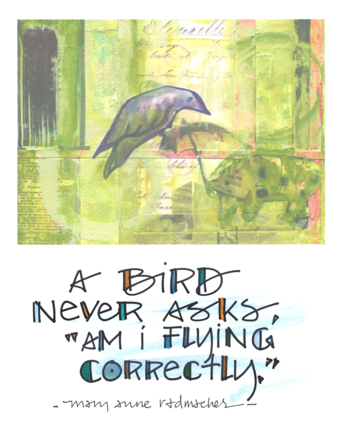
1. What does self-compassion mean, what is it? How would you describe or define it?
Following the model of my behavior toward the human I love and adore the most. Treating myself at least equally as well, if not better. The first time I heard a flight attendant instruct, “Place the oxygen ask on yourself first, before assisting others with theirs,” the metaphor lit up. Immediately.
Listen to yourself. Listen to your truest, kind inner voice.
2. How did you learn self-compassion? Did you have a teacher, a guide, a path, a resource, a book, a moment of clarity or specific experience?
I am still learning self-compassion.
The consequences of not listening to my own instincts, of overriding the messages from my body, have been great. The books that helped me the most are: How to Live in the World and Still be Happy by Hugh Prather; The Key: And the Name of the Key Is Willingness by Cheri Huber. And I’ve read biographies of historical luminaries and taken heed of their great lessons.
While I do not wear a label, nor do I ever singularly identify myself this way – but I grew up with a menu of abuse. And such abuse so early in my life has given me a remarkable opportunity to define how I deserve to be treated. It is an ongoing lesson. From an aha experience when I was 9 that led me to nearly break an abuser’s jaw with the instruction,”Never again,” to the legal document that I delivered to an abuser just a few years ago. It was the shortest letter I’ve ever written in my life. And it’s the last thing I ever wrote to that source of mistreatment. What did it say? “No.”
Because I am so empathetic it’s tempting to put myself second, or last. To imagine that someone needs something more than I do. Now – I’m inclined to occasionally eat the last piece of something on a plate. I don’t save the best for others: I share it with others, yes. But I use it myself.
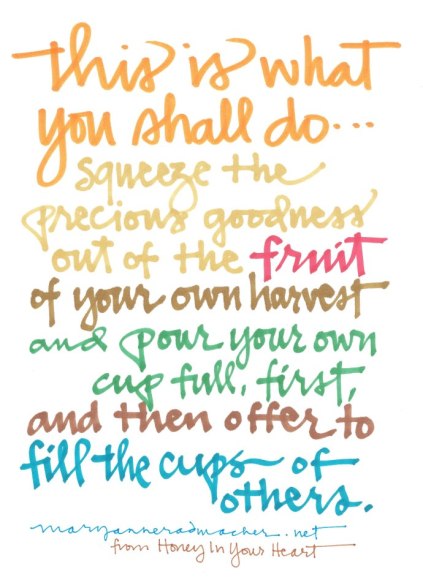
3. How do you practice self-compassion, what does that experience look like for you?
I nap whenever I need to. I no longer use the word “deadline” in common exchange. I say, “targeted completion date.” With due respect to Yoda, I am now inclined to say, “I will try – and if it’s not going to work for me, I will let you know.” And then I do. Try. And say “no” if it’s not a fit.
I have a ruler that has the 12 measures of what is most important to me. If opportunities come to be that are AWESOME but are outside the scope of what matters to me in the moment…I lovingly say No. Without regret. Or apology. My “no,” given truly, is always someone else’s, “Yes.”
I actively live within my own story. It’s self check. “Is this your story or someone else’s story? Is this YOUR job or someone else’s job?” What joy I experienced when I recognized I was only responsible for – me! AND the companion realization to that is, “No one else is responsible for me or my happiness.” Blammo. Blame goes out the window. I own my stuff and I don’t blame it on others.

4. What do you still need to learn, to know, to understand? What is missing from your practice of self-compassion, what do you still struggle with?
4A. What do you still need to learn, to know, to understand?
Yeah. This is a tough one. What I think I still need to learn hardly ever turns out to be what the next lesson is. Life has a way of dishing up whatever the next lesson is. So I can answer – that I still need to better understand how to notice the lessons before they hit me over the head.
4B. What is missing from your practice of self-compassion.
Dynamic physicality. I write. I create. I administer. I teach on line. That can read, I sit. I sit. I sit. And when I’m done sitting, I sit some more. The hula hoop I made is sitting in the garage. I dance to get my engine started in the morning. For minutes. Just for mental joy…not for body benefit. Oh, dang. I’ll write it: e x e r c i s e. Yep. I try calling it playground time. Play. I am inclined toward stillness. And yet I know my practice needs movement. Baby steps. Big dog – I’m his person and I walk him. It’s a self compassion trick…because THE DOG needs the walk. I go. So clearly plenty of opportunity for learning here.
4C. What do you still struggle with?
I learned five years ago that I have extreme sensitivity to gluten, eggs and cow-dairy. Just recently studying the Aryuvedic disciplines, the Kapha path is helping me manage my health and sensitivities in ways that make so much sense and are having very positive results. No nuts. Little red meat. Already embraced gluten-free, egg-free and cow-dairy free styles. The struggle? Sometimes I will willingly trade, against all common sense, two days of feeling great for ten minutes of a huge cheese cake slice. Or, half a cheese cake. My self talk improves the ratio of times I pass to times I succumb. “What are you actually feeding?” “Is the trade really worth it?” “Is there an alternative that will satisfy this craving that would serve you better?” Increasingly the answers to these questions help me make a more viable choice for myself. But there are times when only half of a Trader Joe’s cheesecake will do. And slowly those times occur with less frequency.
In summary: So now I refer myself, and you, back to the whole harm and unraveling thing that I began with. My self-compassion is tied to Forgiveness.
Forgiveness. It’s my newell post. My cornerstone. My balancing point. My net. My invitation to a more compassionate life.

I am filled with love and gratitude for Mary Anne, and especially thankful for what she had to say about forgiveness. To find out more about Mary Anne, to connect with her:
- Visit her website
- Buy some of her art or one of her books
- Read her Belief Net blog
- Like her official Facebook page
- Follow her on Twitter
- Watch one of her YouTube videos
- Go to Patti Digh’s Design Your Life Camp and attend a session with Mary Anne, who’ll be teaching
Next on Self-Compassion Saturday: Andrea Scher.
P.S. If you didn’t see the first post in this series, you might want to read Self-Compassion Saturday: The Beginning.

 Open Space Practice, (AKA: A Thousand Shades of Gray)