
I wrote this at the last meeting of my Wild Writing class this session. The prompt was “Music for Guitar and Stone” by Ruth Schwartz.
On our walk this morning, after being on our own for a whole week, two days longer than planned because of the snow, I start thinking about discomfort. The first “noble truth” of Buddhism is that life is suffering, but that’s hard for people to get their heads around. It gets confused with the perspective “everything sucks, so what’s the point?”
It’s easier for me to understand it as “life is uncomfortable.” And what follows is that the source of that discomfort is our desire to be comfortable. It pulls us out of every moment, a constant longing for some other now.
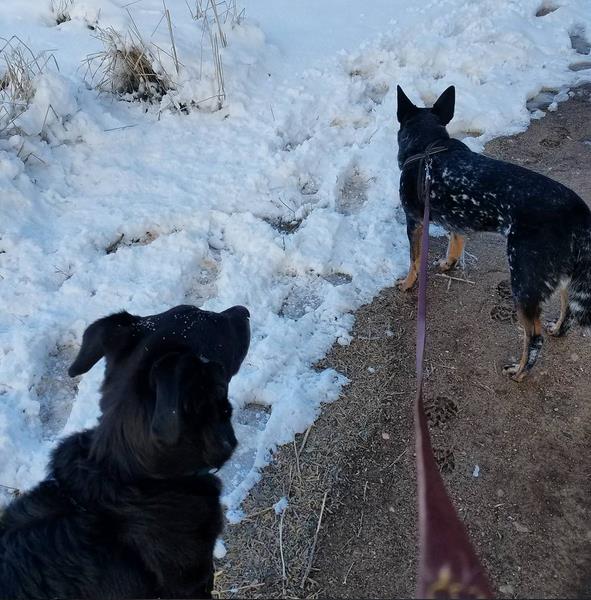
As we walk, my thinking, my internal narrative is constantly interrupted by the need to reroute, because of mud or another dog and its person heading straight for us or a rabbit frozen on the side of the path or a pile of horse poop. It’s also interrupted by the need to respond to the dogs, a tangled leash or the young one about to eat something he shouldn’t.
And that makes me think of the way Susan Piver shifted the Four Noble Truths, came up with Four Noble Truths of relationships, of love — the first being that relationships are uncomfortable. She explains that the root of that discomfort is the way we cling to comfort, the ways we blame the other person for causing our discomfort.
I call dogs one of my practices, (along with writing, meditation, and yoga), because in that relationship, primarily on our long daily walks together, I can see all of it — the ways I fuck up, the ways I’m winning, the mundane and the magic. When I see how happy Ringo is to find the perfect stick and carry it, I expand, my heart opens. When he tries to eat a huge pile of cat poop that will surly make him sick, I feel myself contract in fear and irritation. It’s all there, and I’m just trying to get comfortable. I notice that and try to shift, attempting to be okay with the discomfort, to allow it — “where failure is part of the music.”
Registration for the next round of Wild Writing with Laurie Wagner just opened. This time it’s a shorter session, only four weeks. After this, classes won’t start up again until the fall, so if you’ve been wanting to try it this is a great opportunity. It truly is a magic practice and Laurie is an amazing teacher.

 Open Space Practice, (AKA: A Thousand Shades of Gray)