Tag Archives: Self-Compassion Saturday

Self-Compassion Saturday: Sandi Amorim

I don’t remember how I first found Sandi Amorim’s work. I do know that I immediately adored her. She is equal parts fierce and soft, someone who both challenges and comforts me. She was part of the A Year With Myself project that I took part in during 2012, started by Cigdem Kobu, and that fall, I did Reset. Revive. Restart., a collaboration between Cigdem and Sandi.

I got to meet Sandi when I went to World Domination Summit. The story of that initial connection is a bit of magic that I will keep with me always. On the first day, I went to a meet-up hosted by Farnoosh Brock. I was keeping my eye out for Sandi, because I knew she was supposed to be there too. In my pocket was a heart-shaped rock I’d found on the beach. When I found it, I thought to myself, “I’m going to take this and give it to Sandi.” What I didn’t know is that for years Sandi has been collecting heart-shaped rocks. So when I finally saw her, I went over, told her who I was, hugged her and sat next to her — and I mean next to her, even though we were meeting for the first time, I feel like I needed to be as close as possible, stopped just short of crawling into her lap — and handed her the rock.

She gave me the funniest look. At first I thought I had somehow offended her, done something wrong. She finally said, “How did you know I collected these?” I laughed, relieved that I hadn’t upset her, and said, “I didn’t. I just knew when I found it that I wanted to bring it to you.”

As a coach, Sandi is “An instigator. The spark to your flame. Ruthlessly compassionate. I’ll do whatever it takes to have you shine.” I am so happy to share her perspective on self-compassion with you today.

sandibadass1. What does self-compassion mean, what is it? How would you describe or define it?

Whenever I’m in doubt or curious about what a word actually means, I go straight to my dictionary – a nerdy habit I’ve had since childhood – and what often amazes me is how watered down or altered many words become over time.

com·pas·sion: a feeling of deep sympathy and sorrow for another, accompanied by a strong desire to alleviate the suffering

Brene Brown says, “Until we can receive with an open heart, we are never really giving with an open heart.” This quote made me realize that even though I’ve come a long way with self-compassion, it’s a practice that needs ongoing nurturing. I’m quick to do what I can to alleviate the suffering of others, but sometimes what I need for myself is completely hidden from my view.

My greatest challenge and learning from this practice is that self-care and compassion has to come first – not after I’ve taken care of others, or done my work for the day, etc. but as my first priority.

sandilove2. How did you learn self-compassion? Did you have a teacher, a guide, a path, a resource, a book, a moment of clarity or specific experience?

One of my first mentors said to me many years ago, “If you treated others the way you treat yourself, you’d have no friends.” I’ve never forgotten the truthful sting of his words, and it’s both haunted and guided me throughout my personal growth journey. Is it handled? No, but I’m more aware of it now than I’ve ever been. The tools I use to nurture this mindfulness include meditation, writing, photography, and silent retreats. Of all of them, it is silence which has been my greatest teacher on compassion, both for myself and others. There is nothing quite like being alone with yourself after a few days of silence. It is, for me, the space where self-compassion is most natural.

Another teacher has been my body, and it has been a patient and persistent teacher. The lesson was loud and clear – if I don’t listen the first time it communicates, it will keep sending more, increasingly intense messages. For most of my life I took my health and body for granted, so when it began sending the messages that something had to change, I paid no attention. The impact of this was huge, and it’s taken a major shift in self-care to restore my energy and well-being. It was a hard lesson to learn, but looking back I can appreciate it now as it woke me up to what was needed – that strong desire to alleviate suffering (in myself) from the definition above.

My dog Tarty has quickly become a new guide on this journey of self-compassion. She is unapologetic in putting her needs first, and in respecting her needs, I am learning to take care of my own.

sandyandtarty3. How do you practice self-compassion, what does that experience look like for you?

After I turned 50, I began taking a daily self portrait to document what I call ‘the year of living 50’ and the experience has been profound. More than looking in a mirror, when I sit with an image of myself – some days dressed and ready to greet the world, other days bare-faced and bed-headed – I’m confronted by my own humanity and how harshly I’ve judged myself over the years. Being with myself in this way has been difficult – and exquisite. When I look in the mirror now after a few months of this practice, I see a woman worthy of love. A woman I love.

dreamysandy4. What do you still need to learn, to know, to understand? What is missing from your practice of self-compassion, what do you still struggle with?

Some days I feel obsessed with the need to understand why this is such an ongoing struggle, not just for myself but for most women I know. The only way I know to understand is to keep moving forward myself, to keep peeling back the layers, and keep exposing the tender heart within. What’s missing? Patience. Always patience.

sandi01I am so grateful to Sandi, for these responses, but also for her wisdom and her friendship, her fierce love and presence in the world. To find out more about Sandi, to connect with her:

Next on Self-Compassion Saturday: Cigdem Kobu.

P.S. If you didn’t see the first post in this series, you might want to read Self-Compassion Saturday: The Beginning. Or make your way through all the posts tagged Self-Compassion Saturday.

Self-Compassion Saturday: Jennifer Matesa

I first found Jennifer Matesa’s blog, Guinevere Gets Sober, when I was doing some internet research on addiction. I don’t remember the exact thing I was searching for, could have been as general and nonspecific as “addiction,” as it is an ongoing theme in my life, something I am always working with.

I was immediately struck by the fierce honesty of Jennifer’s writing, like a wind so strong you almost can’t keep your eyes open or breathe, that in the end clears everything out, makes you feel clean and alive, awake. She was able to verbalize things I knew in my gut, had experienced, made me feel sane around something that can feel so crazy, so out of control, so threatening and desperate.

The more I’ve gotten to know her, read her work, the more I adore her. We have a lot in common — dogs, meditation, writing, and teaching, and oh yeah, addiction. She is also an amazing artist, a loving and present mom, a beautiful mess of a human, and a total badass. I am so glad to share her with you today, specifically her perspective on self-compassion.

jennifermatesa021. What does self-compassion mean, what is it? How would you describe or define it?

In modern parlance, the word “passion” means strong feeling, more colloquially strong sexual feeling, but the root of the word is a Latin word meaning “to suffer.” So we get Christ’s “passion,” his trip to the cross, for example. So if we add the prefix com-, the word to me means “to suffer with.” And that’s a hard job to do—when someone is suffering, to suffer along with them.

We all know that life is about suffering. Even when it’s about joy, it’s about suffering (see below). Most of us want to know that we’re not alone in that suffering. And because it can be hard to establish a truly loving community—even a community of two, say in a marriage—humans will go to great lengths to numb out the suffering, using food, drugs, booze, gambling, sexuality, exercise, you name it. We put something into our bodies that makes us not-care. Today we have really top-shelf designer chemicals, including designer sugars, that can help us numb out.

So really the bottom line, the existential problem here, is that we all face life and its joys and challenges alone—and even joys can make us suffer, because the edge of true joy is so sharp (see even further below). And we know joy won’t last. But we want to make it last, or we want to numb out our fear of it not-lasting.

jenniferhandwritingI write a lot about addiction and recovery, I report from the body, and I’ve come to think of drug-use and addiction as self-abandonment. When I’m in my addiction, I abandon myself. This is one of the most powerful ideas I’ve learned.

Self-compassion is an antidote. Self-compassion asks me to be my most reliable companion on the spiral staircase of life. I may have other companions along the way, but only my Self will be with me 24/7.

2. How did you learn self-compassion? Did you have a teacher, a guide, a path, a resource, a book, a moment of clarity or specific experience?

For me it’s an ongoing project. I grew up in an alcoholic family that was by turns crazy and preternaturally calm, as in the calm before the storm. I learned first to ally my feelings with the crazy-makers, to take care of the people who were going nuts so I could try to hold off the downpour. Of course, this is an impossible project—an anti-rain dance. People call this “codependence.” I’ve started calling it self-abandonment.

I’m learning self-compassion on a day-to-day basis by practicing the principles that helped me detox off a shitload of painkillers five years ago. I never, ever, ever thought I’d be able to quit taking those drugs, I was on such a high level for so long, and after years on them I had no idea how to live without them. (More and more these days, physicians and addiction professionals are claiming that folks like me are sort of genetically unable to live without drugs, which I’m happy to offer living proof is wrong.) I have a community of people around me who are able to live chemical-free and, at no charge, they’ve passed down the principles that allow them to do this. Without practicing those principles, I’d either be dead or in prison. The basis of those principles is deep, authentic self-love.

jennifershadowBy “practice” I mean just that. Like a kid who has to practice his piano scales for half an hour a day. Like a kid who has to stand in front of the ball-feeder and hit her forehand. It’s spiritual fitness, it’s just practice. Which means I need to expect to hit a few foul balls. Which is such a relief after expecting myself to bat .1000 for the first 40-some years of my life.

I’ve read Stephen Mitchell’s translations, and Pema Chodron and Thich Nhat Hanh. But I’m more grounded in literature. Shakespeare (both plays and sonnets), Karen Armstrong, Mary Karr, David Foster Wallace, Terry Tempest Williams, Kathleen Norris, Adrienne Rich, Toi Derricotte, Sharon Olds, and too many others to choose, including anonymous stories of people who have found moments—sometimes long stretches—of self-compassion. I also love children’s books. Roald Dahl, Russell Hobbs, John Burningham. Quentin Blake’s Zagazoo is one of the most amazing stories of self-compassion I’ve ever read. The characters in his many books practice accepting their own idiosyncrasies and oddities and beauty and sadness, living inside the light places and the dark ones. I’m glad to have read them to my son when he was a little boy. I believe they shaped his consciousness.

jenniferflowerI’ve had many moments of clarity. Quite often they’re small moments that carry great power. I’ll tell you a story about the most recent one. This July I visited New York City and Fire Island. So I have almost four years sober, and five years off drugs that could have killed me, and I drove to Manhattan with my new road bike and met up with a friend who’s an athlete with 30-some years sober. He also grew up in an alcoholic family, and we have a lot to talk about. He took me on a 12-mile nighttime ride through the city, starting in West Harlem, through Morningside and a couple circuits around Central Park, then finally down the length of Fifth Avenue from 59th Street. The Fifth Avenue stretch was three miles—on a Saturday night, prime club-hopping time, no bike lane, yellow cabs weaving in and out like swarms of bees. I relaxed into following this person I trust and at one point nearly got squeezed by two cabs fighting for a spot at the curb. My instincts saved me. I realized that, at any moment, a cab could take either one of us out for good. Yet there we were, speeding down Fifth Avenue on a clear Saturday night, completely present and aware, telling stories at red lights, choosing to do something with our bodies other than drinking and partying and spending tons of money, and of course there’s no language that’s not cliché to describe the gestalt of the scene — “center of the universe”? “heart of civilization”? the core of the Big Apple, blah blah blah. I thought, “We’re out of our fucking minds!” And then I thought of watching my mother die at 58 of lung cancer from a lifetime of chain-smoking, I thought about her abusive childhood that was more damaging than mine, and I thought about how she’d never done anything like this in her life. Not anything like it. She was living in a deeper insanity than I do. The next day I stepped onto a ferry to Fire Island and I’d left my car and my bike in the lot on the mainland, and I had just a few necessities, and a close friend was coming to meet me at the dock, and as I sat on the top deck watching the sun set and the fog roll in over the sound I felt enormous joy in my chest, white-light, as if my ribs would rip apart.

jennifermatesa3. How do you practice self-compassion, what does that experience look like for you?

Here’s the important part of the story I just told: at the moment I felt that joy, my mind told me, You don’t get to feel this. That’s the divide that happens, the moment when I have a choice about whether to practice self-compassion. I don’t get to feel this. But when I sank back into my body, when I allowed myself to feel what my body was feeling, I realized, I’m feeling joy. It’s real.

The body does not lie. That’s why I say I report from the body. All my books and a lot of my other stuff is about that. My new blog does that, and so will my forthcoming book.

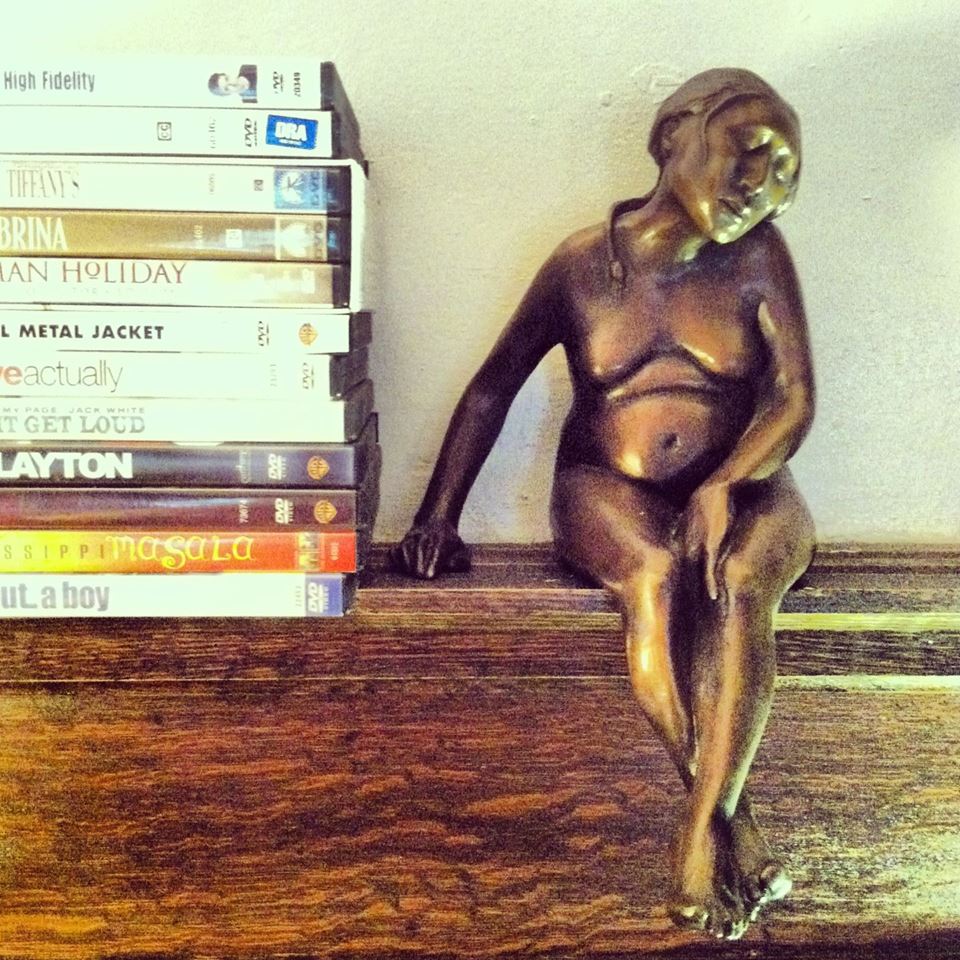
jenniferbronze

Bronze cast by Roxanne Swentzell, Santa Clara Pueblo, N.M.

4. What do you still need to learn, to know, to understand? What is missing from your practice of self-compassion, what do you still struggle with?

I struggle with understanding what’s real and what’s not real. I live a great deal of the day in my head. As a kid I learned to deal with family stress by making up stories, or imagining myself into other people’s stories—either in books or the lives of other real people. Because much of the time Real Reality was intolerable. So I just Made Up Shit. I made up my own reality, and I lived there for a long time. This instinct is as old in me as my heart is. I still have pajamas and a pillow in that space.

I mean, this is normal to an extent. Human imagination is divinely designed to relieve us of the pain of reality, and it’s also there to enlarge human experience through creativity, the making of art and the expansion of perception. Imagination is very old: the cave paintings at Lascaux and Altamira accomplish all that stuff. I’m reading a book about the evolution of singing, and it turns out we learned to sing not only as a survival tool to scare the lions away but also as a method of moving into trance, into our own imaginations, into contact with emotion and spirit. Singing helped change the shapes of our bodies and minds; it helped us ask the first question. No other ground-dwelling animal sings. Human beings need that experience of expansive perception. But craving it, using imagination compulsively to break from reality, using it to the point where you can’t tell reality from unreality is, in its further stages, I think, called psychosis!

So my self-compassion practice today is about distinguishing reality from my imaginings and fantasies and fears. What helps is meditation, prayer (whatever that is), and checking in with people I’m pretty sure are sane and healthy and relatively content.

jenniferselfportrait

self-portrait

I am so grateful to Jennifer, for taking part in this series and for continuing to write, work, and live in a way that makes things clear, showing up for what is hard, for what hurts, and finding a way through it, offering up her experience, her path as a map to others. Jennifer is working on a new book about physical recovery from addiction to be released next year, and is a 2013 fellow at the Substance Abuse and Mental Health Services Administration. To find out more about Jennifer, to connect with her:

Next on Self-Compassion Saturday: Sandi Amorim.

P.S. If you didn’t see the first post in this series, you might want to read Self-Compassion Saturday: The Beginning. Or make your way through all the posts tagged Self-Compassion Saturday.